A small business loan for restaurants can come from a bank, an SBA-backed lender, or an alternative lender. Banks and SBA loans usually cost less and run longer, but they ask for time, tax returns and strong credit. Alternative lenders can fund in days based on bank statements and card sales, at a higher cost you should measure in APR before you sign.
What a Restaurant Small Business Loan Usually Covers #
Restaurant owners borrow for a short list of reasons: a walk-in cooler dies on a Friday, the hood system gets flagged on inspection, the dining room needs a refresh, or payroll runs short during a slow stretch. Each one has a different payback clock. Equipment lasts years. Payroll gets repaid out of next month's sales.
Match the loan length to what you bought. A five-year loan on a fryer that lasts about five years makes sense. An eight-month loan on a dining room remodel usually does not. The remodel keeps earning long after the payments end, and short-term payments will squeeze your cash.
Restaurants also run on a particular cash cycle. You collect at the register every day, but you pay produce and dairy vendors on net-7 to net-30 terms and payroll every one or two weeks. Seasonality adds another layer: patio season, holiday catering and school calendars all move sales up and down. A loan that ignores that rhythm will hurt in the slow months, no matter how good the rate looks on paper.
What Lenders Check Before They Say Yes #
Banks and SBA lenders look at the traditional file: personal and business credit, time in business (often two years or more), business and personal tax returns, a profit and loss statement, and a debt schedule showing you can cover all payments. They will also ask about collateral and a personal guarantee.
Alternative lenders look at cash flow. They review average monthly deposits, card processing volume, daily balances, and the number of negative or NSF days. They also check for existing advances and how much of your receipts already go to other lenders. Credit still matters to them, but usually as one factor, not the gate.
Restaurant-specific details count too. Lenders watch for large unexplained cash withdrawals, owner draws that drain the account before payroll, and lease terms that show how long you can stay in the space. A clean lease with years left is worth more than a busy social media account.
Bank and SBA Loans: Lower Cost, Longer Wait #
A bank term loan or an SBA 7(a) loan is usually the cheapest money a restaurant can get. The term is longer, the rate depends on your credit and collateral, and the payment is easier to plan around. The federal government guarantees part of an SBA loan, which lets banks approve some borrowers they would otherwise decline. For a well-documented owner with a few good years behind them, these are the right tool.
The trade-off is time and paperwork. Expect to provide two or three years of tax returns, a personal financial statement, a business plan, and your lease. Approval often takes weeks, and SBA files can take longer. A bank rarely sees a Tuesday cash shortfall and funds by Thursday. If your books are thin or you opened last spring, the answer is often no, however busy the dining room is.
| Option | Typical cost | Speed | What it needs |
|---|---|---|---|
| Bank term loan | Lowest rates in this group, set by credit and collateral | Often 30 to 90 days | Two or more years of tax returns, collateral, strong credit |
| SBA 7(a) loan | Rate capped by SBA rules and tied to a base rate; longer term | Often 60 to 120 days | Same as bank, plus SBA paperwork and a personal guarantee |
| Bank line of credit | Interest charged only on the amount you draw | Weeks to set up, then available on demand | Credit review, financial statements, sometimes collateral |
Alternative Loans: Faster Funding, Higher Cost #
This is where we work, and it is what banks generally do not offer: speed, approval based on revenue rather than years of tax returns, and often no real estate collateral. (Many alternative lenders do file a UCC lien on business assets or ask for a personal guarantee.) A merchant cash advance or revenue-based financing can fund in days if your deposits and card sales show steady volume. If a $12,000 walk-in compressor dies on Thursday and a wedding is booked for Saturday, that speed has real value.
The cost is higher, and you should see it clearly. Most alternative products are priced with a factor rate, which is a multiplier on the amount advanced, not an interest rate. Take $50,000 at a 1.25 factor, repaid over eight months (≈ 65–75% APR). You pay back $62,500. That looks like 25%, but because you repay over eight months and the balance falls with each payment, the annual cost is far higher. A shorter payback pushes the APR higher still.
Equipment financing sits in between. The equipment itself secures the loan, so approval is often easier than for an unsecured advance. It fits a new oven, a hood system, or a refrigerated prep table, and the term can match the equipment's useful life.
| Option | Typical cost | Speed | What it needs |
|---|---|---|---|
| Merchant cash advance | Factor rate (for example, 1.25 over 8 months ≈ 65–75% APR); well above bank pricing | Often days | Card processing history, bank deposits |
| Revenue-based financing | Fixed fee or factor tied to revenue (for example, 1.25 over 8 months ≈ 65–75% APR); APR rises as payback speeds up | Often days | Bank statements, sales history |
| Equipment financing | Rate tied to credit and equipment value; usually priced between bank and alternative | Days to a few weeks | Equipment quote, credit review, sometimes a down payment |
The speed is worth the price when a bank would say no or take too long, and the money protects revenue you would otherwise lose. It is not worth it for a slow project you could finance through a bank or SBA loan at lower cost.
Working Out the True Cost in APR Terms #
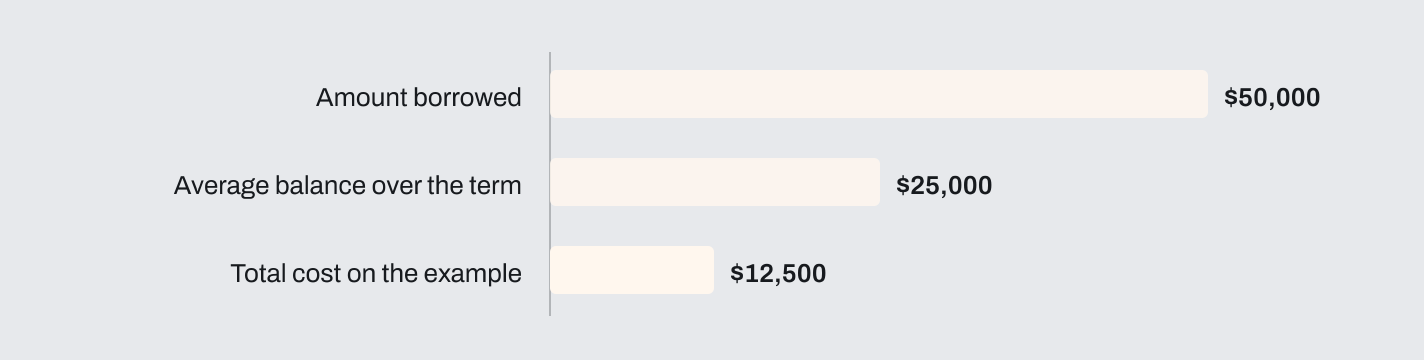
Start with total cost: total repayment minus the amount borrowed. On the $50,000 example, that is $12,500. But total cost is not a rate. To compare options, convert it to an annual rate.
Here is the step most owners skip. You do not hold the full $50,000 for all eight months, because each payment pays down the balance. The average balance over the term is closer to half the original amount. So the $12,500 cost on an average balance of about $25,000 is 50% over eight months. Annualized, that is about 75%. Payment-by-payment calculations land a little lower, which is why we quote 65–75% APR for a 1.25 factor over eight months. Methods differ, so ask any lender for the APR in writing.
Compare that with a bank term loan at, for example, 10% APR. The bank loan costs far less over the life of the debt and leaves more cash in the register each week. That is the trade-off in plain numbers.
Before you sign with any lender, ask for these in writing:
- Total repayment amount
- Term and payment frequency
- Any origination or broker fees
- Any UCC filing fees
- Whether early payoff reduces the cost
- What happens to payments in a slow week
Also check whether the lender takes a fixed daily or weekly amount or a percentage of card sales. A percentage holdback can feel fine in a busy month and squeeze you in January.
Matching the Loan to the Job #
Match the product to what you are buying and how long it will earn. Long-life assets like kitchen equipment, a build-out, or real estate fit longer, lower-cost money: a bank term loan, an SBA 7(a), or equipment financing secured by the asset. Seasonal working capital, such as stocking up before the holidays or covering a slow winter, fits a line of credit, which you draw on only when needed. A short emergency, like a repair that cannot wait, can fit a revenue-based advance if the payback works with your weekly sales.
Payroll gaps are the trickiest. Try a line of credit first. If the gap comes from a one-time event and you have no line, a short advance may be the only way to cover payroll, but only if you can repay it without starving the next one.
Will a Restaurant Loan Approval Depend on My Credit Score? #
Banks and SBA lenders usually want a personal credit score in the good range, and they weigh it heavily along with cash flow and collateral. Alternative lenders put more weight on deposits and card volume and treat credit as one input among several. A lower score does not automatically end the conversation with an alternative lender, but it can affect pricing and terms. Compare offers rather than accepting the first one.
How Long Does It Take to Get a Small Business Loan for a Restaurant? #
Bank term loans often take several weeks from application to funding. SBA 7(a) loans can take longer, sometimes two to four months, because of the added paperwork. Equipment financing and lines of credit can move faster once your file is complete. Alternative advances and revenue-based financing can fund within days if your bank statements and card history are ready. Having three to six months of statements, your lease, and an equipment quote in hand shortens any timeline.
Can I Get a Loan for a Restaurant With Bad Credit? #
Sometimes. Bank and SBA lenders are harder to qualify for with weak credit, though not impossible if collateral and cash flow are strong. Revenue-based financing and merchant cash advances put more weight on sales volume, so a lower personal score may not block approval. Expect higher pricing and shorter terms in return. Before you borrow, convert the offer to APR, and make sure the weekly or daily payment fits your slowest month, not your best one.
Do Lenders Look at My Card Sales or Only My Tax Returns? #
It depends on the lender. Banks and SBA lenders focus mostly on tax returns, profit and loss statements, and debt coverage. Alternative lenders look at card processing history and bank deposits, often over the last three to six months, because those show how money moves through your restaurant week to week. Some restaurants qualify on card sales and deposits alone when volume is steady. Keep both sets of records ready so you can approach either kind of lender.
Is a Loan Better Than a Line of Credit for Buying Equipment? #
For a specific piece of equipment with a known price, a loan usually fits better. You get a fixed amount, a term matched to the equipment's life, and a payment you can plan around. A line of credit suits uncertain or repeated needs, like seasonal inventory or occasional repairs, because you draw only what you use. Equipment financing often combines the strengths of both, since the equipment secures the loan and approval can be easier. Compare the APR on each before you choose.
Fit Checks: When Our Money Makes Sense and When It Doesn't #
Our products make sense when a restaurant has steady card sales, needs cash within days, and can see the payback fitting inside its weekly margins. They make less sense for a slow project you could finance through a bank, for a business with thin or inconsistent deposits, or for any situation where the daily or weekly payment would strain payroll. If a bank or SBA loan fits your timeline and documents, it is almost always the cheaper choice, and we would rather you take it than borrow at a higher cost you did not need.
Ready to see what your sales support? Start your request.
Sources #
This guide is general information, not advice for your situation. Figures are illustrative; every factor rate is shown with its APR-equivalent; the terms that apply to you are only those in an agreement you sign. How we work and how we are paid.