Restaurant financing means borrowing against your sales, equipment or credit to pay for a build-out, new equipment, inventory or a payroll gap. Bank loans and SBA 7(a) loans usually cost the least and run the longest, but they are slow and paperwork-heavy, so they suit planned projects.
What restaurant financing actually pays for #
Restaurant cash does not move in a straight line. You buy produce Monday, pay the fish order Wednesday, and the card batches land two or three days after each sale. The gap between paying suppliers and collecting from guests is where most restaurants feel the squeeze.
Common uses include:
- Build-outs: construction, permits, plumbing, and the rent you pay before the doors open.
- Equipment: hoods, walk-ins, ranges, dishwashers and POS hardware.
- Inventory and opening stock: the first full order of proteins, dry goods and beverages.
- Payroll bridges: covering a slow January or the week after a holiday dip.
- Repairs that can't wait: a compressor that dies on a July Saturday.
The most common mistake is a mismatch. Funding a walk-in cooler that will last ten years with a six-month, daily-repayment advance means you pay short-term prices for long-term value. Funding Friday's payroll with a loan that takes ninety days to close means the money arrives after the problem.
How lenders look at a restaurant: revenue, seasonality and card sales #
Lenders read your bank statements and your card processor statements. They look at monthly revenue, average daily balance, returned payments and card deposit trends over the last three to twelve months.
Seasonality matters. A beach restaurant that does most of its volume in June and July will show a deep trough in the winter. A lender wants to see that you can get through that trough, not just that your summer was strong. If your statements show a clean dip and a clean recovery, that is a good sign. If they show repeated overdrafts in the slow months, expect questions.
Card sales carry extra weight with some products. Many revenue-based and advance-style lenders treat card deposits as a proxy for revenue, since they can see them directly. Bank and SBA lenders weigh your personal and business credit, time in business, tax returns and collateral more heavily.
Bank term loans and SBA 7(a): lower cost, slower approval #
A bank term loan usually carries the lowest cost of the options here, if your credit is solid, you have a few years of history, and your tax filings are clean. It is quoted as an APR, and repayment is fixed monthly over a set term, often several years for equipment and working capital.
An SBA 7(a) loan is a bank loan partly guaranteed by the Small Business Administration. Its rates are capped under SBA rules, and terms can run up to 10 years for most working capital and equipment and up to 25 years for real estate. That length keeps monthly payments manageable for a large build-out.
Where these fall short for many restaurant owners is speed and eligibility. They approve on tax returns, financial statements and collateral, often require a personal guarantee, and can take weeks or months. A restaurant with strong sales but a weak personal credit score may not qualify at all.
Right tool for the job: a planned build-out, a building purchase, or equipment with a multi-year life, when you have sixty days or more and the paperwork in order.
Lines of credit and short-term loans: flexible access to cash #
A line of credit gives you a set limit you can draw on as needed. You pay interest only on what you draw, and you can repay and draw again. For a restaurant that needs cash for seasonal gaps or for uneven supplier timing, that flexibility is useful. Costs are quoted as an APR on the drawn balance, and some lenders add annual or draw fees. Setup can take a few weeks, but once it is open, a draw can often happen within a day.
A short-term business loan is a lump sum repaid in fixed payments over roughly three to eighteen months. It is often priced as a factor rate or an APR. Read the quote closely. A factor rate of 1.25 over eight months works out to roughly 70–80% APR, which is far above a bank line, so use short-term loans for needs that truly are short.
Right tool for the job: a seasonal gap you can see coming, or a cash cushion you may use and then repay, with a steady deposit history to support it.
Merchant cash advances and revenue-based financing: fast money, higher cost #
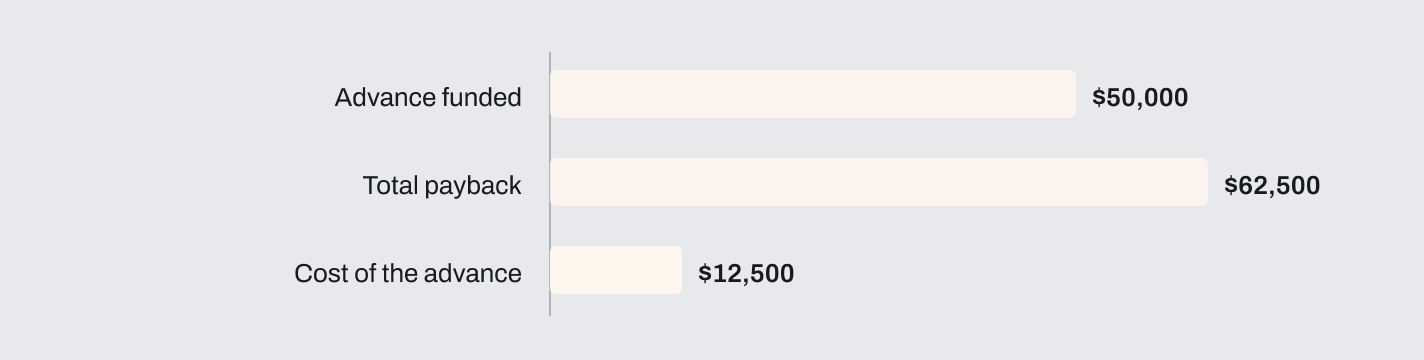
A merchant cash advance (MCA) gives you cash in exchange for a share of future card sales or a fixed daily or weekly debit from your bank account. The total payback is the advance multiplied by a factor rate. A $50,000 advance at a 1.25 factor means you repay $62,500, so the cost is $12,500.
That $12,500 is not an interest rate. Spread over eight months, with most of the balance paid down during the term, it is roughly 70–80% APR. The fast funding, often within a few business days after statements are reviewed, is what you are paying for. Most MCAs do not require hard collateral, though many still require a personal guarantee.
Revenue-based financing works differently. You repay a fixed percentage of monthly revenue until a capped total is reached. The payments shrink in slow months, which helps with seasonality. The cap sets the total cost, and the APR depends on how quickly your revenue comes in. The trade-off is that a daily or percentage holdback reduces the cash you have in a slow week. Stacking several advances at once is the classic trap: each one takes its share of the same card sales.
Right tool for the job: a true emergency, a deal that expires this week, or a short-term need with a clear, fast payoff, and a sales history that can carry the holdback.
How to choose: match the tool to the job and the payback window #
Start with two questions. How long will the thing you are buying last? And how fast do you need the money? A tool should match both answers. Don't use a six-month advance for a ten-year asset, and don't wait ninety days for a loan to cover a payroll due Friday.
We work through a network of funding partners, so the offers you see will vary by your sales, credit and time in business. Use this table to compare the categories:
| Option | Typical cost | Speed | What it needs |
|---|---|---|---|
| Bank term loan | Lowest APR for strong credit; quoted as APR | Several weeks to a few months | Tax returns, financial statements, time in business; often collateral and a personal guarantee |
| SBA 7(a) loan | APR capped under SBA rules; often lower than the other options | Usually a month or more, longer with paperwork | Tax returns, business plan, personal guarantee, solid credit history |
| Line of credit | APR on the drawn balance; may carry fees | Setup in weeks; draws in about a day | Bank statements, time in business, credit review |
| Short-term business loan | Factor or APR; 1.25 factor over 8 months ≈ 70–80% APR | Days to a couple of weeks | Several months of bank statements and steady deposits |
| Merchant cash advance | Factor rate; 1.25 factor over 8 months ≈ 70–80% APR | Often a few business days | Card sales history, processor and bank statements |
| Revenue-based financing | Capped total payback; APR depends on repayment pace | Days to a couple of weeks | Monthly revenue history, bank or processor access |
Can I get restaurant financing with bad personal credit? #
Sometimes. Bank and SBA lenders weigh personal credit heavily, so a weak score often rules them out or sends you toward another product. Products underwritten on card sales and bank deposits look harder at revenue, which makes approval more possible. Expect a higher cost and a shorter payback. Before you sign, check that the payment fits a slow month, not just a good one. Your sales have to carry the payment on their own.
What is the cheapest way to finance a restaurant? #
For most owners with solid credit and time to wait, a bank term loan or SBA 7(a) loan is the cheapest, quoted as an APR and spread over years. A line of credit is often next, since you pay interest only on what you draw. Cheapest is not always best, though. The cheapest loan that takes ninety days does not help on Friday. Compare the APR, the fees and any prepayment terms.
How long does restaurant financing take to approve? #
Merchant cash advances and short-term loans can fund within a few business days once statements are reviewed. Lines of credit take weeks to set up, then can be drawn within a day. Bank term loans usually take several weeks to a few months, and SBA loans often take longer because of the forms and the SBA review. Ask each lender for the funding date, not just the approval date.
Do I need collateral to borrow for a restaurant? #
Bank and SBA loans often require collateral, such as equipment, real estate or a lien on business assets, plus a personal guarantee from owners with significant stakes. Merchant cash advances and revenue-based financing usually do not require hard collateral, but many still ask for a personal guarantee. Read the agreement before you sign. A guarantee means your personal assets may be at risk if the business cannot pay.
How do I convert a factor rate into an APR so I can compare offers? #
A factor rate is the total payback divided by the amount funded. A 1.25 factor on $50,000 means you repay $62,500, a cost of $12,500. To estimate APR, divide the cost by the average balance outstanding, then divide by the term in years. Because you pay the balance down over time, the average is about half the advance. For eight months: $12,500 ÷ ($25,000 × 0.67) ≈ 75%. Real repayment pace moves the number, so treat it as an estimate and use the same method for every offer.
When is a bank loan a better choice than fast funding? #
When the money is for a planned project with time to spend: a build-out, a kitchen expansion, a building purchase, or equipment that will last for years. If your credit and revenue are strong and you can wait several weeks, a bank or SBA loan usually costs less over the full term. Fast money is the wrong tool for a five-year asset, because you would pay short-term prices for long-term value.
Where each tool earns its keep, and where it doesn't #
Fast funding earns its keep when a deal expires this week, a compressor fails in the middle of service, or a short seasonal gap has a clear end date. It doesn't earn its keep for a long-lived asset, for a need you can plan months ahead, or when the holdback would leave you short on payroll in a slow week. Bank and SBA loans earn their keep on planned, long-lived projects where cost matters most. They are not built for an urgent Friday.
Before you choose, convert every factor rate to an APR, check the repayment against your slowest month, and make sure the term matches the life of what you are buying.
Next step: start your request, and compare the offers side by side before you sign anything.
Sources #
This guide is general information, not advice for your situation. Figures are illustrative; every factor rate is shown with its APR-equivalent; the terms that apply to you are only those in an agreement you sign. How we work and how we are paid.